| 25 Kashmiri journalists threatened over past year
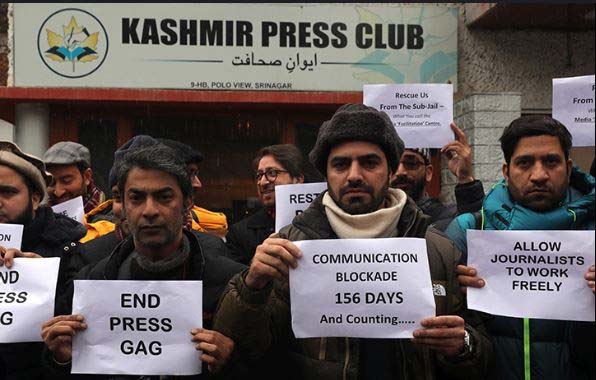
WR Desk: The recent summoning of journalists to police stations in Indian illegally occupied Jammu and Kashmir (IIOJK) over their reporting on the profiling of imams and mosques has drawn strong condemnation from local and international press organizations.
According to Kashmir Media Service, Germany’s Deutsche Welle (DW) reported that the practice of summoning journalists and forcing them to sign pledges have been strongly criticized by the Committee to Protect Journalists (CPJ), Editors Guild of India (EGI), Press Club of India (PCI), Kashmir Press Club, Delhi Union of Journalists (DUJ), and several other media bodies. They have called for an immediate end to threats against journalists, emphasizing that such extraordinary measures have no place in a democracy.
DUJ President Sujata Madhok told DW that the police decision to summon and intimidate journalists over their reports is condemnable. She urged the government to stop targeting reporters for doing their work and called on editors and media owners to stand in solidarity with their staff. PCI President Sangeeta Barooah Pisharoty said the police action interferes with journalists’ core responsibilities. She noted that detaining reporters for up to 15 hours over four days and forcing them to sign bonds constitutes clear harassment, creating an atmosphere of fear that undermines journalists’ constitutional right to work freely.
Media organizations have demanded an end to harassment and insist that journalists be protected from any unreasonable police action while carrying out their duties.
The Indian Express reported that its Srinagar bureau journalist and assistant editor Basharat Masood was summoned to the city’s Cyber Police Station for four consecutive days and asked to sign a bond. Masood, who has been reporting from Srinagar for the past 20 years, refused to sign. The police did not provide a clear explaination for his summons, though an officer cited one of his news reports as the reason. Similarly, Hindustan Times reporter Ashiq Hussain received a verbal summons, which the newspaper requested in writing for accountability.
Reuters reported that two other journalists were also summoned, though one was traveling and the other did not appear at the station. Both requested anonymity due to the sensitive nature of the matter.
Journalists said that over the past six years, their families have also suffered psychological pressure, forcing many reporters into self-censorship. Several who spoke on condition of remaining anonymous said the issue is only now gaining attention because senior journalists were targeted. Freelance reporters, they added, have long faced uncertainty and intimidation.
They noted, “If journalists are summoned even for minor reports, one can imagine the fear within the press community when attempting serious investigative work in Kashmir.”
Indian digital media platform Newslaundry reported that around 25 Kashmiri journalists faced threats over the past year. It further stated that since the revocation of occupied Jammu and Kashmir’s special status by the Modi government in August 2019, journalists’ families have also endured psychological pressure. Many reporters have resorted to self-censorship; some spent years in prison, others remain incarcerated, some face travel restrictions, and several have abandoned the profession out of fear.
CPJ Asia-Pacific Program Coordinator Kunal Majumder, said, “Using police powers to summon journalists over their legitimate reporting is part of a pattern of intimidation against the media in Jammu and Kashmir.” He urged authorities to cease their harassment and ensure that journalists are not subjected to arbitrary police action for doing their jobs.
|