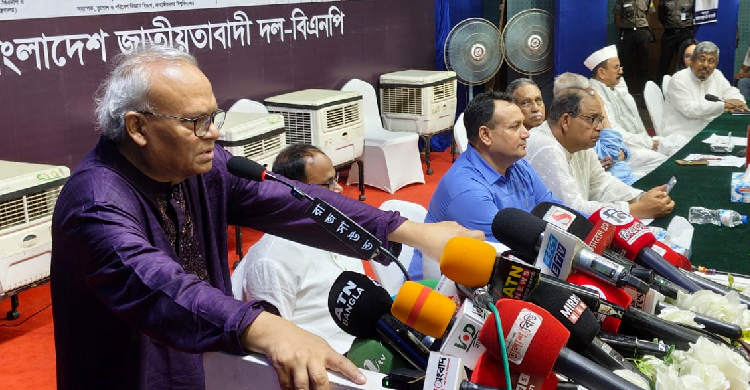
| Political Adviser to the Prime Minister and Senior Joint Secretary General of BNP, Ruhul Kabir Rizvi, has said the Farakka Barrage is inflicting environmental and economic damage not only on Bangladesh but also on India.
He made the remarks on Saturday while chairing a discussion organised by the BNP to observe Historic Farakka Day, commemorating the May 16 Farakka Long March.
Rizvi stressed the importance of preserving the legacy of the movement and passing its history to younger generations. “We are gradually forgetting this chapter of our history. If this trend continues, the next generation may not even be aware of its significance,” he said.
He noted that although the party has marked Farakka Day in previous years through statements, this time it arranged a broader discussion involving experts and resource persons to deepen understanding among leaders and activists aligned with nationalist politics.
Emphasising the BNP’s foreign policy stance, Rizvi said the party supports constructive ties with neighbouring countries, but those relations must be grounded in dignity and mutual respect.
Questioning the original rationale behind the Farakka Barrage, he cited Indian engineer Kapil Bhattacharya, who had warned about the project’s potential negative consequences decades ago.
According to Rizvi, Bhattacharya had described the barrage as a looming disaster and even resigned in protest. He alleged that such warnings were disregarded by Indian policymakers.
Rizvi also referred to comments attributed to Bihar Chief Minister Nitish Kumar, who has reportedly called for dismantling the barrage due to its adverse impact within India. He said parts of Bihar have experienced unseasonal flooding and environmental stress linked to the structure.
In addition, he mentioned Indian environmental activists Medha Patkar and Himanshu Thakkar as critics of the Farakka project, arguing that it has long term ecological implications for India as well.
Rizvi questioned whether ensuring navigability at Kolkata Port justified what he described as environmental harm to Bangladesh. He said the reduction in Ganges water flow has contributed to salinity intrusion, ecological degradation and arsenic contamination in groundwater in several Bangladeshi districts, including Rajshahi, Rangpur, Pabna, Sirajganj, Kushtia and Jessore.
Drawing a comparison with river management efforts in the United States, he noted that some dams there have been dismantled to restore natural watercourses.
“If a river’s natural flow is obstructed and diverted, it eventually dies. In the long run, no one benefits, not even India,” Rizvi said.
|