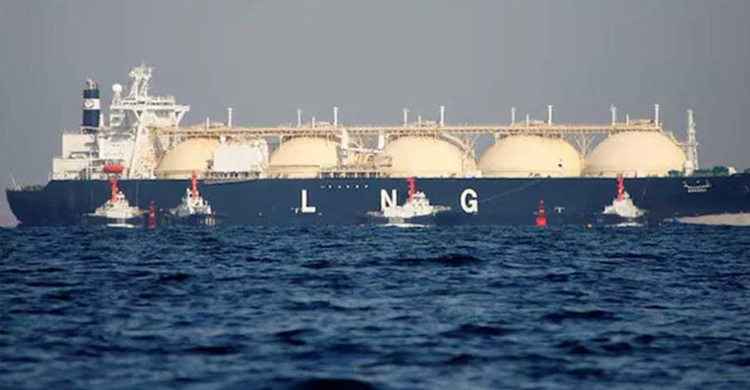
| The government has approved the import of five cargoes of liquefied natural gas (LNG) from Switzerland, the United Kingdom and Singapore to help meet the country`s growing energy demand.
The approval came at a meeting of the Cabinet Committee on Government Purchase held at the Secretariat on Wednesday, with Finance Adviser Amir Khasru Mahmud Chowdhury in the chair.
According to officials, three LNG cargoes will be procured through the Request for Quotation (RFQ)-International method under Rule 105(3)(a) of the Public Procurement Rules 2025 following a proposal from the Energy and Mineral Resources Division.
Under the approved proposal, the 26th cargo will be delivered on June 26-27, the 27th cargo on June 30-July 1, and the 28th cargo on July 6-7, 2026.
Of the three cargoes, one will be supplied by Singapore-based BP Singapore Pte Ltd, while the remaining two will be sourced from UK-based TotalEnergies Gas and Power Ltd. The total cost of procuring these three cargoes has been estimated at Tk 2,372.21 crore, including applicable taxes.
The committee also approved another proposal to import two LNG cargoes from Switzerland in 2026 through a direct purchase method. The final cost of these two cargoes has yet to be determined.
Sources concerned said Switzerland-based SOCAR Trading SA had submitted a proposal expressing interest in supplying LNG on both short- and long-term government-to-government (G2G) arrangements, as well as in establishing a Floating Storage and Regasification Unit (FSRU).
A meeting of the Advisory Committee on Economic Affairs held on December 20 last year had given in-principle approval to import a number of LNG cargoes from SOCAR Trading SA in 2026 under a G2G framework.
Officials said the latest approval would allow Bangladesh to procure two LNG cargoes from SOCAR Trading SA at a negotiated price based on the Japan-Korea Marker (JKM) formula, set at JKM plus US$0.125 per MMBtu. The move is expected to provide a cost-effective alternative to spot market purchases.
Each LNG cargo will contain approximately 3.36 million MMBtu of LNG, according to the proposal approved by the committee.
|