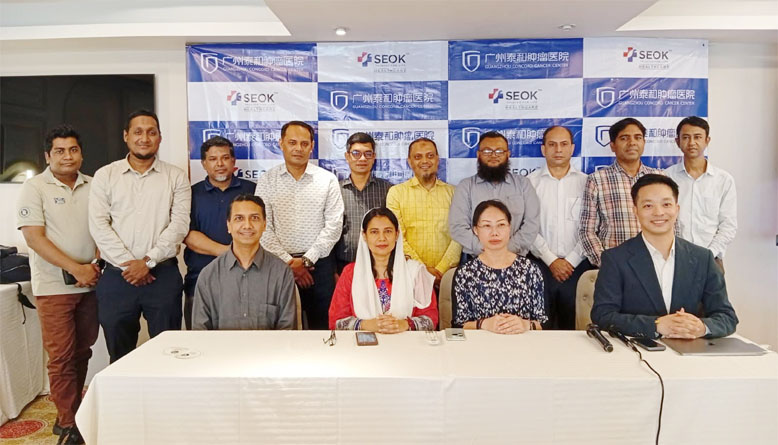
| MM Rahmatullah: Access to advanced cancer treatment is increasingly becoming a global healthcare issue, with patients and families often looking beyond national borders when they require highly specialized diagnostics, complex surgery or sophisticated radiotherapy. Against this backdrop, a new initiative by SEOK Healthcare is seeking to create greater access for Bangladeshi patients to specialized oncology services in China through cooperation with Guangzhou Concord Cancer Center (GCCC).
A press meets and hospital introduction event featuring GuangzhouConcordCancerCenter was held on Sunday at Hotel Unique Regency in Dhaka. The programme brought together healthcare stakeholders, media representatives and others interested in international cancer treatment, precision oncology and cross-border medical cooperation.
Mr Masumuzzaman and Farhana Hasna Tuli from SEOK Healthcare, and EWAN You and Stephanie ZHOU from Guangzhou Concord Cancer Center in China were presented as negotiators.
Organized by SEOK Healthcare, the event focused on introducing the facilities, treatment technologies and international patient services available at GuangzhouConcordCancerCenter, an oncology-focused hospital in Guangzhou, Guangdong Province, China.
The initiative comes at a time when more Bangladeshi patients are seeking specialized treatment overseas and when international healthcare providers are increasingly looking to build structured referral and patient-support networks in Bangladesh.
Cancer treatment can involve a highly complex combination of surgery, systemic therapy, radiotherapy, pathology and diagnostic imaging. Depending on the disease, patients may require access to treatment technologies or multidisciplinary expertise that is not readily available in every healthcare system.
GuangzhouConcordCancerCenter offers a range of oncology services, including surgery, chemotherapy, targeted therapy, immunotherapy and advanced radiotherapy. The hospital also follows a multidisciplinary approach in which specialists from different fields can contribute to the assessment and management of individual patients.
One of the centre`s most notable areas of focus is proton therapy, an advanced form of radiation treatment that can deliver radiation with greater precision in selected cases. Because proton therapy can potentially reduce radiation exposure to surrounding healthy tissue, it may have particular applications for certain tumours and patient groups.
According to information provided by the hospital, its proton therapy centre began clinical operations in December 2024 and is described by GCCC as the first operational proton therapy centre in South China. The centre reported that it had treated more than 800 patients by April 2026.
However, specialists emphasise that sophisticated technology should not be confused with universally appropriate treatment.
Proton therapy is not required for every cancer patient. Whether it is appropriate depends on factors including the type and location of the tumour, disease stage, previous treatment, the patient`s overall condition and specialist clinical recommendations.
For patients considering treatment abroad, the most important question is therefore not simply where the newest technology is available, but whether a particular treatment is medically appropriate for their individual condition.
The Dhaka programme is part of a broader relationship between SEOK Healthcare and GuangzhouConcordCancerCenter that has been developing over recent months.
In March 2026, a Bangladeshi delegation involving representatives of SEOK Healthcare, the Department of Mass Communication and other organisations visited GuangzhouConcordCancerCenter.
During the visit, discussions covered precision oncology, international patient management, medical referral systems, insurance-related support and potential long-term cooperation between the two sides.
The delegation also toured the hospital`s proton therapy facilities and received presentations covering proton therapy technology, its clinical applications and services designed for international patients.
According to the hospital`s account of the visit, SEOK Healthcare CEO and Co-Founder M.M. Masumuzzaman highlighted the importance of medical consultation, international patient coordination and cooperation with Chinese healthcare institutions in helping patients navigate complex treatment journeys.
The partnership received further exposure in May, when GuangzhouConcordCancerCenter participated in the 17th Dhaka International Medical Equipment Exhibition. The hospital showcased its proton therapy technology and precision oncology capabilities to healthcare professionals and prospective patients from Bangladesh and other South Asian countries.
For SEOK Healthcare, the relationship with GCCC forms part of a broader model of international medical assistance rather than simply a hospital-referral arrangement.
Over the last three years, the organisation says it has served more than 4,000 patients, providing medical treatment coordination and patient-support services.
SEOK Healthcare describes itself as a Bangladesh-based healthcare service and medical referral organisation affiliated with more than 75 hospitals and institutions worldwide. The organisation says its network includes more than 1,000 physicians associated with internationally recognised institutions.
According to SEOK Healthcare, the involvement of physicians is important because doctors can better understand an individual patient`s medical condition and help tailor the treatment pathway rather than treating international healthcare as a one-size-fits-all process.
That philosophy is reflected in the organisation`s range of services, which extends from the early stages of medical evaluation to travel and post-treatment support.
For patients, the journey can begin with a virtual consultation and a review of existing medical records. Where necessary, SEOK Healthcare can facilitate a second medical opinion concerning a diagnosis or proposed treatment plan.
SEOK Healthcare also assists with practical aspects of overseas treatment, including travel planning, visa-related support, accommodation and coordination during the patient`s stay.
In other words, its stated role is not limited to sending a patient to a foreign hospital. It aims to provide a form of end-to-end coordination — helping patients and their families navigate the medical and logistical challenges that accompany treatment abroad.
A cancer diagnosis can leave patients and families facing difficult decisions within a short period of time. Questions about diagnosis, treatment options, prognosis, cost and where treatment should take place can become overwhelming.
This is where medical referral organisations can play an important coordinating role, provided that clinical decisions remain in the hands of qualified medical professionals.
SEOK Healthcare`s model places emphasis on obtaining specialist opinions before treatment decisions are finalised. This can be particularly relevant when patients are considering advanced or high-cost treatments overseas.
A patient`s pathology reports, imaging, previous treatment records and other clinical information should ideally be reviewed before a treatment recommendation is made.
Such an approach can help patients distinguish between a treatment that is technologically available and a treatment that is clinically suitable.
For patients travelling from Bangladesh, access to treatment is only one part of the equation. International patients must also navigate medical documentation, communication, travel, accommodation and follow-up care.
According to GuangzhouConcordCancerCenter, its international patient services cover several stages of the treatment journey, including preliminary medical-record assessment, referral coordination, visa assistance, interpretation, treatment support and post-treatment follow-up.
For Bangladeshi families, such coordination can reduce some of the logistical difficulties associated with seeking cancer treatment abroad.
Nevertheless, patients should obtain a clear understanding of the full treatment pathway before travelling. This includes asking about the proposed treatment, expected benefits, potential risks and side effects, treatment duration, total estimated costs, accommodation and arrangements for follow-up after returning home.
The growing availability of proton therapy and other advanced cancer technologies has generated significant interest among patients worldwide. But sophisticated equipment alone cannot determine whether a treatment is appropriate.
A patient`s diagnosis, tumour characteristics, disease stage, previous therapies, age, general health and treatment objectives all influence the clinical decision-making process.
For that reason, international treatment decisions should be based on independent medical assessment and evidence-based recommendations rather than promotional material alone.
This principle is particularly important for Bangladeshi patients considering overseas treatment. Before making a decision, patients should prepare their pathology reports, diagnostic imaging, laboratory results, previous treatment records and other relevant medical documents and have them reviewed by qualified specialists.
They should also seek clarity about the complete financial and clinical pathway before committing to treatment.
The SEOK Healthcare-GCCC initiative also points to a broader trend in healthcare cooperation between Bangladesh and China.
China has developed a large and increasingly sophisticated medical sector, while Bangladesh has a substantial population of patients seeking specialised treatment overseas. Structured partnerships can potentially create additional pathways for medical consultation, referral, specialist opinion and advanced treatment.
At the same time, international referrals should complement — rather than replace — efforts to strengthen Bangladesh`s own healthcare infrastructure.
Improving cancer screening, early diagnosis, pathology, radiotherapy, surgical oncology, chemotherapy services and multidisciplinary cancer care within Bangladesh remains essential to improving outcomes for patients.
International cooperation can nevertheless provide an additional layer of choice, particularly for cases requiring specialised expertise or technologies that may not yet be widely available locally.
What distinguishes the emerging SEOK Healthcare model is its emphasis on accompanying patients throughout the process.
The organisation says its support can begin before a patient leaves Bangladesh, continue through consultations and treatment abroad, and extend into the post-treatment period.
From virtual medical consultation and second opinions to travel arrangements and hotel stays, the stated objective is to provide patients and their families with a coordinated pathway rather than leaving them to manage each stage independently.
For families dealing with cancer, that continuity can be significant. Medical treatment is only one part of the experience; communication, documentation, travel, accommodation, financial planning and follow-up can all affect the patient`s overall journey.
The Dhaka press meet, therefore, represents more than the introduction of a foreign cancer hospital.
It reflects an emerging effort to connect Bangladeshi patients and healthcare professionals with international oncology expertise while building stronger institutional links between Bangladesh and China.
For GuangzhouConcordCancerCenter, the growing relationship with Bangladesh creates an avenue to introduce its oncology services, precision-treatment capabilities and international patient programme to a new market.
For SEOK Healthcare, the initiative fits into a larger mission of connecting Bangladeshi patients with specialised medical institutions and physicians around the world.
And for patients, the real value of such cooperation will ultimately be measured not by the sophistication of a machine or the number of international affiliations, but by whether it leads to better-informed decisions, appropriate treatment, transparent costs, qualified medical advice and continuity of care.
As cancer care becomes increasingly specialised, access to information and expertise is becoming almost as important as access to technology.
The growing cooperation between SEOK Healthcare and Guangzhou Concord Cancer Center suggests that Bangladesh`s international healthcare landscape is entering another phase — one in which medical referral, specialist consultation, advanced oncology and patient-support services increasingly converge around the individual patient.
|