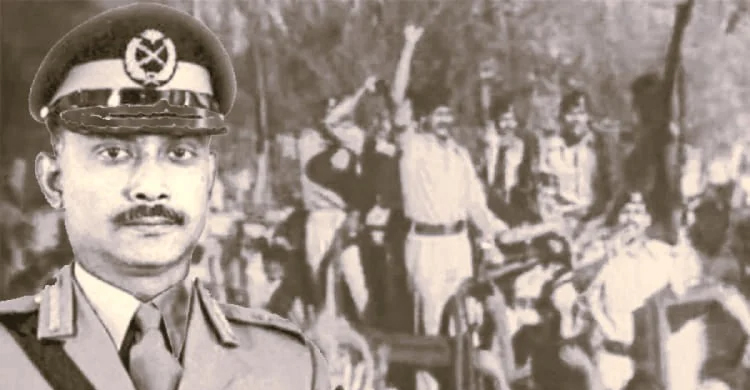
| (BSS) : The events of 7 November 1975 marked a major turning point in the life of army commander and Liberation War veteran Ziaur Rahman, as well as in the history of Bangladesh’s future politics. It was the Sepoy-People’s Revolution on that day that drew Ziaur Rahman, the great Proclaimer of Bangladesh’s Independence and a leading figure in the Liberation War, into the country’s political arena and placed him in the role of the nation’s great helmsman at a critical juncture in its history.
Although Ziaur Rahman had received military training in the People’s Republic of China as a soldier, he was not involved in any class-struggle organisation or revolutionary politics. After the Liberation War, he entered democratic politics based on Bangladeshi nationalism, founded the Bangladesh Nationalist Party (BNP) in 1978 and provided significant leadership in the administration of the state of Bangladesh.
Despite coming from outside conventional politics, Ziaur Rahman demonstrated an exceptional ability to understand Bangladesh’s geopolitical, socio-economic and cultural circumstances, as well as its natural environment and prevailing conditions.
Following the Sepoy-People’s Revolution of 7 November, he consolidated his power and influence within the machinery of the state and swiftly sought to establish a democratic, development-oriented political system based on Bangladeshi nationalism.
This made him immensely popular, from the country’s villages and rural communities to its towns and cities. In this newly independent country, Ziaur Rahman came forward with a fresh vision and programmes for education, healthcare, agriculture, industry, trade and investment.
From the outset, the people of Bangladesh were drawn to Zia’s leadership and policies. They began to dream of establishing themselves, under his leadership, as a self-reliant nation in the eyes of the world.
They sought to make their independence and sovereignty meaningful in the truest sense by rejecting foreign influence and domination in all its forms. As the leader of one of the world’s most resilient newly independent nations, Ziaur Rahman was determined to unite the entire population of the region—from the hills to the plains—under the distinct identity of Bangladeshi nationalism.
For this reason, in his various activities and wide-ranging national programmes, he did not regard Bengali nationalism and Bangladeshi nationalism as one and the same, nor did he attempt to merge them indiscriminately.
Since ancient times, political thought surrounding Bengali nationalism in the subcontinent has generally been dominated by the cultural traditions, religious practices and customs of Bengali Hindus. The distinctive characteristics and religious observances of Bengali Muslims found little reflection in this framework.
Neither the underlying philosophy of Bankim Chandra Chattopadhyay’s slogan ‘Vande Mataram’ nor the Hindu nationalist ideas associated with Shyama Prasad Mukherjee gave meaningful recognition to the cultural traditions, religious practices, distinct identity or particular characteristics of Bengali Muslims.
The term Bengali nationalism or Bengali culture was generally understood to refer to the ideas, customs, rituals and traditions of the Hindu community. In that sense, the emergence of Bengali nationalism in the nineteenth century was also an expression of cultural and religious change within the Bengali Hindu community.
Although the Bengali nationalist movement and efforts at social reform led by Raja Rammohan Roy and Ishwar Chandra Vidyasagar came to be known as the ‘Bengal Renaissance’, these were largely significant initiatives within the Bengali Hindu community, in which Bengali Muslims had little participation. Moreover, Bengali-speaking followers of Islam were often identified primarily as ‘Muslims’ in ethnic and social terms.
As a result, many influential circles at the time also understood Bengali nationalism to mean activities dominated by Hindu cultural influences. There appears to have been no substantial national initiative aimed at promoting broader solidarity, unity and prosperity among Bengali-speaking Hindus and Muslims as communities.
This may help explain why, despite Muslims constituting the majority in the provinces of Bengal and Punjab at a later stage, both provinces were eventually partitioned.
Against this historical backdrop, and drawing on Bangladesh’s victory in the nine-month armed Liberation War and the need to foster harmony, solidarity and prosperity among citizens living in the hills and plains, Ziaur Rahman sought to build a broader national unity under the banner of Bangladeshi nationalism, irrespective of nationality, religion or race.
The underlying meaning, importance and significance of the Bangladeshi nationalism articulated by Ziaur Rahman, the commander who called the people to Bangladesh’s armed Liberation War, are profound. This concept of nationalism leaves no room for ideological discord, linguistic ambivalence or religious conflict. Nor does it allow for regional antagonism or discrimination.
Ziaur Rahman declared equal rights for all citizens of an independent and sovereign Bangladesh. To realise this objective, he introduced various socio-economic development programmes, prioritising them according to the country’s needs.
Ziaur Rahman’s programmes for nationwide development, progress and prosperity therefore continue to serve as models in many areas. His vision as a statesman extended far beyond Bangladesh’s borders, encompassing neighbouring countries and distant regions alike.
He believed that no developing country could move forward without good relations with its neighbours, improved connectivity, trade and exchange. It was for this reason that he took the initiative to establish the South Asian Association for Regional Cooperation (SAARC), bringing together countries including neighbouring India and Pakistan.
Several major powers, including China, praised Zia’s initiative for regional cooperation. Unfortunately, however, SAARC failed to make much further progress because of persistent problems and tensions between India and Pakistan. Nevertheless, reports suggest that the BNP, the party founded by martyred Zia and now in power, is once again taking various initiatives to advance his vision of regional cooperation and development.
President Ziaur Rahman’s nationwide canal-digging programme, introduced to bring about a Green Revolution in agricultural production, conserve adequate irrigation water and boost fish farming, achieved considerable popularity and success among farmers and the common people.
The programme helped substantially increase agricultural yields and fish production across the country. Recently, after coming to power, martyred Zia’s son and worthy successor, Tarique Rahman, has relaunched canal-digging initiatives in various parts of the country. The programmes have also received a strong response in rural communities.
The establishment of Gram Sarkar, or village government, introduced by Ziaur Rahman nationwide, remains a widely discussed example of an important step towards strengthening democracy and making local government more effective.
There was scarcely an area of national life that Ziaur Rahman did not address or for which he did not introduce an extensive programme during his relatively brief period in power, from 21 April 1977 to 30 May 1981.
A saying still heard across villages and rural communities captures the public perception of his achievements: ‘Whatever Zia touched yielded gold.’
Moreover, General Ziaur Rahman was perhaps the only military figure in a developing country such as ours to withdraw martial law and restore democracy. The Bangladesh Nationalist Party (BNP), which he founded, continues to work towards establishing full democracy and protecting human rights in the country.
In a military coup in 1975, then President Sheikh Mujibur Rahman was killed, and the one-party system he had established, known as BAKSAL, was subsequently banned. At a later stage, Sheikh Hasina, who had been living in India, returned to Bangladesh at the invitation of President Ziaur Rahman and re-established the Bangladesh Awami League.
Moreover, following President Zia’s assassination in mid-1981, his wife, Begum Khaleda Zia, eventually assumed power. During the BNP leader’s tenure, on 6 August 1991, Bangladesh replaced the presidential system of government with a parliamentary system. Observers regard this as another political achievement of the BNP, the moderate democratic party founded by martyred Zia.
Retired Colonel M. A. Hamid wrote: ‘7 November 1975 was indeed a turning point in the life of martyred President Ziaur Rahman and in the politics of Bangladesh. After Ziaur Rahman was freed without resistance in a commando-style operation around midnight, hundreds of soldiers climbed aboard their unit trucks the following morning and headed towards the city, chanting slogans. Before long, the Sepoy Revolution evolved into the historic Sepoy-People’s Revolution. The streets of the city were filled with crowds. Their voices rang out with the slogan: “Sepoys and people are brothers”.’
The events of 7 November described above took place while Lieutenant Colonel Hamid was serving as the station commander in Dhaka. He spent much of that time alongside the valiant Liberation War veteran Ziaur Rahman. After his release, Zia assumed the responsibility of Chief Martial Law Administrator at the request of the armed forces amid the unrest prevailing in the country.
From then on, however, destiny propelled him further along the path of politics. Throughout that journey, Zia never sacrificed the interests of the people. He was their dependable and fearless helmsman. That is why he continues to live on in their collective consciousness to this day.
(The writer is a former Chief Editor and Managing Director of Bangladesh Sangbad Sangstha (BSS), an Ekushey Padak-winning journalist and a freedom fighter. The article was originally written in Bengali and translated by Harun Al Nasif.)
|