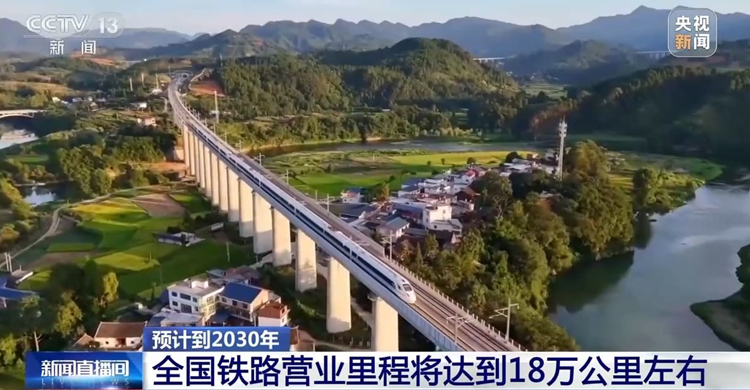
| According to information released at the work conference of China State Railway Group Co., Ltd. held in Beijing, China has achieved remarkable progress in railway development during the period of the 14th Five-Year Plan.
During this period, the total operational length of China’s national railway network expanded from 146,300 kilometers to 165,000 kilometers, representing an increase of 12.8 percent. Notably, the length of high-speed railways grew from 37,900 kilometers to 50,400 kilometers, marking a substantial 32.98 percent increase. Through this rapid expansion, China has firmly established the world’s largest and most advanced high-speed rail network.
In 2025, China State Railway Group accelerated the construction of a modern railway infrastructure system and successfully fulfilled its annual railway construction targets. Total fixed-asset investment in the railway sector nationwide reached 901.5 billion yuan, reflecting a 6 percent year-on-year increase. During the year, 3,109 kilometers of new railway lines were put into operation, including 2,862 kilometers of high-speed rail, clearly demonstrating the railway sector’s strong role in stimulating economic growth.
Throughout 2025, the Group intensified implementation efforts for railway projects under the 102 key projects outlined in the national 14th Five-Year Plan, as well as other major strategic initiatives. Construction commenced on eight major projects, including the Changsha–Ganzhou High-Speed Railway, while operations began on 25 projects, such as the Shenyang–Baishan High-Speed Railway. Logistics infrastructure development was further accelerated, with 52 dedicated railway lines completed.
Looking ahead to the 15th Five-Year Plan period, China State Railway Group will continue to advance railway network development. By 2030, the total operational length of the national railway network is projected to reach approximately 180,000 kilometers, including around 60,000 kilometers of high-speed rail. The proportion of double-track lines and the electrification rate are expected to rise to 64 percent and 78 percent, respectively.
Strategic main corridors will be comprehensively strengthened, the “Eight Vertical and Eight Horizontal” high-speed rail network will take shape, regional connectivity will be significantly enhanced, freight transport capacity will be substantially expanded, and a world-class modern railway network will largely be realized.
Source: Swarna–Hashim–Lili, China Media Group.
|