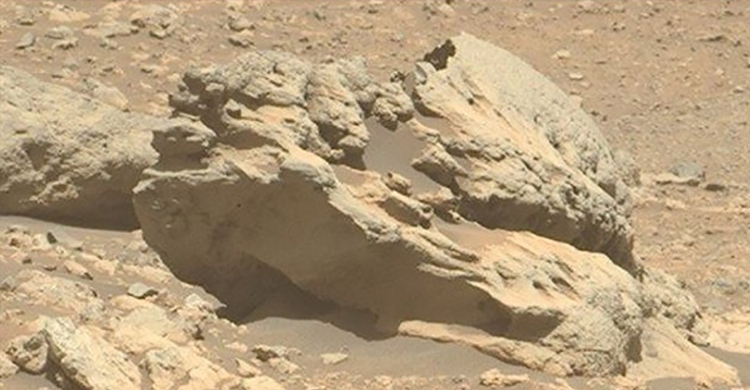
| NASA’s Perseverance rover has discovered an 80-centimetre iron-rich rock on Mars that scientists believe may not be native to the planet.
The rock, named “Phippsaksla,” was spotted on September 19 while the rover was studying bedrock at Vernodden near Jezero Crater.
According to NASA, the rock’s unusual shape and texture stood out sharply from its surroundings. Initial analysis using Perseverance’s SuperCam laser and spectrometers revealed high levels of iron and nickel; a combination rarely found in the Martian crust.
“This element combination is typically linked to iron-nickel meteorites formed in the cores of large asteroids, suggesting the rock originated elsewhere in the solar system,” NASA noted.
The findings strongly indicate that Phippsaksla is likely a meteorite that struck Mars in the distant past. Roughly the size of a small desk, it lies among flat, fractured rock formations that bear little resemblance to its composition.
NASA said additional analysis will be conducted to confirm its origin.
Similar discoveries have been made before. NASA’s Curiosity rover identified iron-nickel meteorites in Gale Crater, including the one-metre-wide “Lebanon” in 2014 and “Cacao” in 2023.
NASA scientists had long wondered why Perseverance had not encountered such meteorites inside Jezero Crater, which is similar in age to Gale.
They now believe the rover may have found one just outside the crater, on ancient bedrock shaped by past impacts.
Source: NDTV
|