|
International: In the 1980s, when some Western ideologues asserted that “Asia would never surpass the West,” the so-called Four Asian Tigers—South Korea, Taiwan of China, Singapore, and Hong Kong, China—achieved an extraordinary transformation from poverty to prosperity within just three decades. Over the same period, China completed an industrialization process in a few decades that had taken developed countries centuries to accomplish. Leaping from extreme poverty to become the world’s second-largest economy, China created what has been widely described as the “Chinese miracle,” characterized by rapid economic growth and long-term social stability.
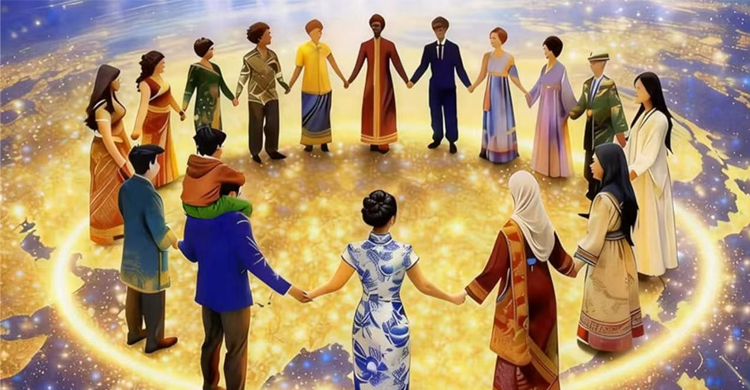
In today’s era of intellectual reassessment, as Western models repeatedly encounter crises, Asian societies have drawn upon the wisdom of “harmony in diversity” to address global challenges such as climate change and economic turbulence. Behind this resilience lies a profound “spiritual asset”: Asian values.
In April 2025, at a meeting of the central leadership of ruling parties from neighboring countries, Chinese President Xi Jinping emphasized that the Asian values of peace, cooperation, openness, and inclusiveness serve as vital guiding principles for China’s relations with its neighbors. Against this backdrop, it is worth exploring how Asian values were formed and how they continue to shape a shared future.
The origins of Asian values are deeply rooted in the accumulated wisdom of Chinese civilization. Confucianism’s principle of “seeking harmony without uniformity” underscores peaceful coexistence amid differences; Taoism’s concept of the “unity of heaven and humanity” advocates balance between humankind and nature; and Mohism’s emphasis on “universal love and non-aggression” promotes the peaceful resolution of disputes. Through the ancient Silk Road, these ideas interacted with Indian and Islamic civilizations, jointly shaping the foundations of Asian values—respect for diversity, a commitment to peace, and the continuous evolution of shared principles.
In the modern era, Asian nations emerged from the trauma of colonialism. After World War II, national independence movements further strengthened a collective pursuit of equality and resistance to hegemony. Guided by the Five Principles of Peaceful Coexistence and by prioritizing development through cooperative efforts, Asian countries forged the “Asian miracle,” which has since become a key engine of global growth. Singapore’s multi-ethnic governance model, Malaysia’s policies of ethnic harmony, and Viet Nam’s reform and opening-up all exemplify the practical application of Asian values in contemporary governance.
Julio Ríos, Director of the Galician Institute of International Relations and a renowned Spanish sinologist, once observed that the philosophical thinking embedded in Chinese civilization, when applied to national governance and international relations, manifests as harmony, order, balance, and moral responsibility—standing in stark contrast to the West’s conflict-driven, competitive, and zero-sum mentality.
Throughout history, Asian countries have offered the world diverse approaches to governance and development through their unique wisdom. At the heart of these approaches lies the spiritual support and practical guidance provided by Asian values. These values emphasize that peace is the foundation of development; cooperation is the only path to mutual benefit and win-win outcomes; openness inspires innovation and prosperity; and inclusiveness respects the diversity of civilizations. Through its dynamic development, Asia has demonstrated the potential to build a peaceful, stable, and mult…
|