| International: Father’s Day, observed on the third Sunday of June each year, is a time when people around the world express gratitude to their fathers and reflect on cherished family memories.
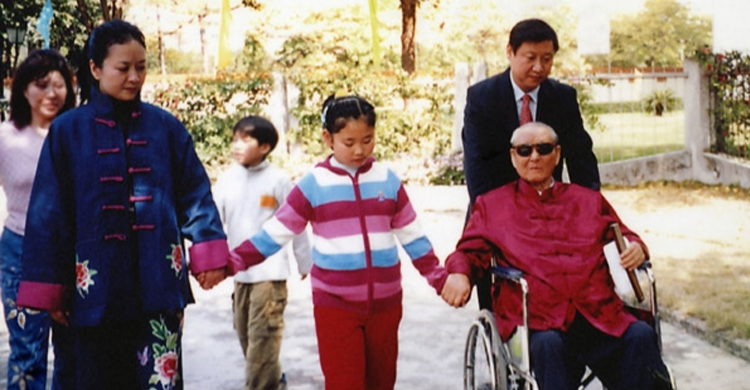
Chinese President Xi Jinping has repeatedly emphasized the importance of family education and values, believing that strong families form the foundation of a strong society. Behind his life philosophy and steadfast commitment to the Chinese people lies the profound influence of his father, Xi Zhongxun (1911–2002). The virtues he inherited from his father—integrity, diligence, and deep concern for ordinary people—have played a vital role in shaping Xi Jinping’s approach to public service.
More than two decades ago, while serving as Governor of Fujian Province, Xi Jinping wrote a letter to his father, a lifelong revolutionary, saying: “My father possesses many noble qualities that I wish to emulate in my own life.” Those values and teachings would later leave a lasting imprint on his political career.
“Stand Firmly with the People”
In January 1969, at the age of 16, Xi Jinping moved to Liangjiahe, a remote village in northwest China’s Shaanxi Province. There, he worked alongside local farmers and experienced the hardships of rural life firsthand.
Reflecting on those years in an autobiographical account, Xi wrote: “My roots as a servant of the people are planted in the Loess Plateau of northern Shaanxi. It was there that my enduring mission was forged—to do practical things for the people.”
At the former Party committee office in Suide County, a phrase attributed to Xi Zhongxun continues to attract attention: “Stand firmly with the people.” Xi Zhongxun once served as the county’s Party secretary, and this principle became a guiding philosophy for his son.
Throughout his long political career—from Liangjiahe to Zhengding, from Fujian to Zhejiang, and from Shanghai to Beijing—Xi Jinping has consistently placed the Communist Party’s fundamental principle of “serving the people” at the center of his work.
Research-Based and People-Centered Leadership
Like his father, Xi Jinping has consistently stressed the importance of field research and understanding problems at their roots.
In August 1978, while studying at Tsinghua University, he accompanied his father—then Party chief of Guangdong Province—on visits to rural communities. Those experiences taught him that lasting solutions can only be achieved by staying close to the people.
He later visited every village in Zhengding County of Hebei Province and nearly every township in Ningde, Fujian Province, to understand local concerns. After being transferred to Zhejiang Province, he toured all 90 counties there in just over a year.
This approach has also been reflected in national policymaking. In formulating China’s 15th Five-Year Plan (2026–2030), Xi Jinping emphasized integrating top-level planning with public consultation to ensure policies respond to the needs and aspirations of the people.
A Family Tradition of Integrity and Frugality
Frugality and discipline were deeply embedded in the Xi family tradition. In a letter written on his father’s 88th birthday in 2001, Xi Jinping noted:
“My father lives a remarkably simple life. His strict standards in raising us are widely known. It was through his teachings and influence that we developed habits of hard work and thrift from an early age.”
Speaking at the annual session of the National People’s Congress in 2018, Xi remarked: “Even today, wasting a single grain of rice at home is unacceptable. The tradition of diligence and frugality should always be preserved.”
Despite holding the country’s highest office, Xi Jinping has continued to underscore the importance of family values. At a conference in 2016, he said:
“Family education has many dimensions, but above all, it is about teaching people how to become good human beings.”
Xi Zhongxun once remarked: “For a Communist Party member, there is no greater joy or pride than working for the people on behalf of the Party.”
Guided by his father’s words and example, Xi Jinping has devoted his life to improving the well-being of the Chinese people.
Source: CMG Bangla.
|