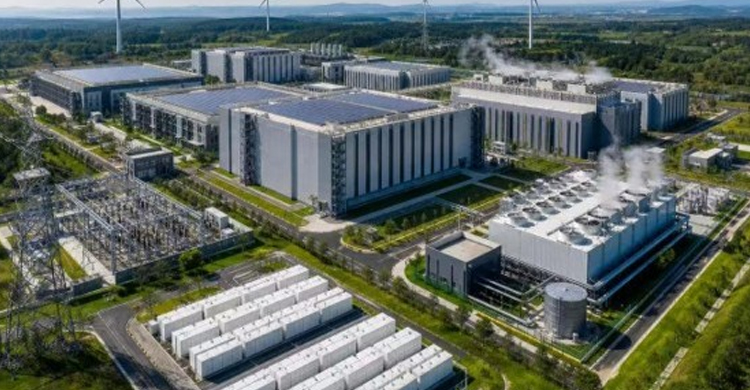
| International: China’s Ministry of Industry and Information Technology (MIIT) recently issued a notice on the organization and implementation of national-level zero-carbon factory development, outlining specific measures for building zero-carbon factories nationwide, including zero-carbon computing facilities.
What exactly is a zero-carbon factory? He Kebin, Dean of the Institute for Carbon Neutrality at Tsinghua University, said that a zero-carbon factory does not mean absolutely “zero” carbon dioxide emissions. Rather, it involves fully tapping the potential for emissions reduction through systematic measures such as technological innovation, structural adjustment and optimized management.
Under current technological and economic conditions, the goal is to keep a factory’s carbon dioxide emissions at the lowest technically feasible level while achieving the greatest possible emissions reductions and continuous improvement.
China has introduced a series of policies this year to promote the development of zero-carbon factories and guide industrial enterprises in exploring practical pathways toward zero-carbon production. These measures range from joint guiding opinions issued by five government departments to the 15th Five-Year Plan, which proposed the development of zero-carbon factories and industrial parks, and the subsequent 15th Five-Year Plan for the Green and Low-Carbon Development of Industry, which explicitly called for the development and construction of 500 zero-carbon factories.
The latest notice marks a transition in China’s zero-carbon factory initiative from top-level policy design to full-scale implementation.
An official from the Department of Energy Conservation and Comprehensive Utilization of the Ministry of Industry and Information Technology said the notice adopts a phased and tiered development approach. It identifies manufacturing enterprises and computing facilities with a solid foundation, clearly defined development objectives and specific implementation pathways, and requires them to commit to completing their construction targets within specified timeframes.
“These facilities will be given priority for inclusion in the national-level zero-carbon factory development list, where they will serve as benchmarks,” the official said.
What will a zero-carbon factory look like? The notice identifies three key indicators: carbon emissions per unit of energy consumption, the proportion of non-fossil energy in total energy use, and the proportion of electricity consumption derived from physically verified non-fossil energy sources.
However, these three core indicators alone do not determine whether a facility qualifies as a zero-carbon factory. A comprehensive assessment is required, covering factors such as the effectiveness of construction, the rationality of implementation approaches, the reliability of data, the standardization of management and the driving mechanisms behind the initiative.
How should zero-carbon factories be built? The notice uses an evaluation indicator system as a guide and outlines implementation pathways covering multiple areas, including scientific carbon accounting, carbon reduction at the source, process-based decarbonization, coordinated carbon reduction and intelligent carbon management.
Coordinated carbon reduction is considered a crucial supporting element in the development of zero-carbon factories. Cao Xueqin, Deputy Secretary-General of the Chinese Institute of Electronics, said computing facilities are among the fastest-growing energy-consuming sectors in China.
Electricity consumption by computing facilities is estimated to account for around 1.6 percent of total national electricity consumption by 2025.
Intelligent carbon management is a key pathway toward building zero-carbon factories. The notice proposes the development and operation of digital energy and carbon management platforms, while encouraging the adoption of technologies including artificial intelligence, the Industrial Internet, the Internet of Things, big data and blockchain.
How can the quality of construction be ensured? The notice emphasizes the timely adjustment and improvement of construction plans, the establishment of a regular monitoring mechanism and the timely tracking of construction progress.
It also makes clear that the development of zero-carbon factories should not rely on a one-off assessment and certification process. Instead, priority should be given to technology, construction and operational performance, ensuring that zero-carbon development becomes a continuous process of improvement rather than a one-time achievement.
Source: Lily-Alim-Suborna, China Media Group.
|