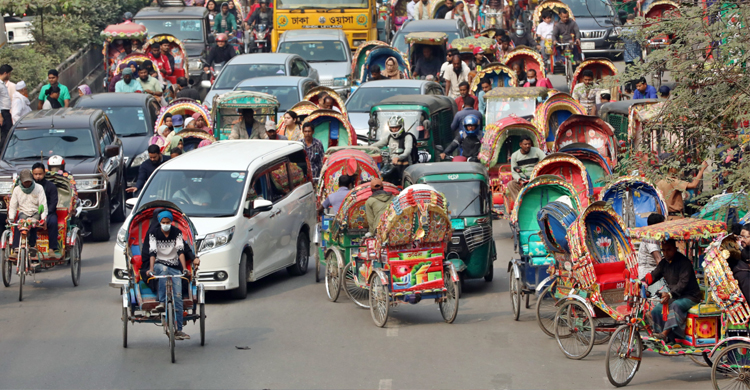
| (BSS) - The government has introduced a comprehensive regulatory framework to bring battery-powered three-wheeler rickshaws (e-rickshaws) under control across all city corporation areas, making registration mandatory and empowering city corporations to regulate their numbers, routes, zones and technical standards.
Under the new rules, no e-rickshaw will be allowed to operate without valid registration. City corporations, in consultation with traffic authorities and with prior government approval, will determine the permissible number of vehicles, designate routes and zones, introduce specific colour codes and enforce speed limits.
The regulations also cover vehicle fitness, driver training, passenger capacity, battery charging, environmental protection and road safety to curb uncontrolled growth and improve urban traffic management.
The Local Government Division issued the Three-Wheeled Low-Speed Battery-Operated Rickshaw (E-Rickshaw) Movement Rules, 2026 through a gazette notification on October 29, bringing them into immediate effect.
Senior Secretary of the Local Government Division Md Shahidul Hasan told BSS that the rules had been introduced to establish discipline in e-rickshaw operations and improve urban transport management.
"We want registration and movement of e-rickshaws to be regulated under a uniform policy in all city corporations across the country. This will help prevent an uncontrolled increase in the number of vehicles and ensure passenger safety," he said, adding that all city corporations would gradually be brought under the rules.
To obtain registration, an applicant must be a Bangladeshi citizen and submit a prescribed application with a national identity card, two recent passport-size photographs, fee deposit receipt and fitness certificate.
The concerned city corporation will examine the vehicle against technical standards and safety features prescribed by the Bangladesh University of Engineering and Technology (BUET).
Registration must be granted within 30 working days if all requirements are fulfilled. If an application is rejected, the reasons must be communicated in writing within seven working days. An aggrieved applicant may appeal to the higher authority within 10 working days of receiving the decision.
A maximum of five e-rickshaws can be registered against one national identity card, either with one or multiple city corporations. However, a vehicle registered in one city corporation cannot operate commercially in another.
The one-time registration fee is Tk 8,000 for a two-passenger e-rickshaw and Tk 10,000 for a four-passenger vehicle. Annual renewal fees are Tk 4,000 and Tk 5,000 respectively, while a fitness certificate will cost Tk 1,000.
Each registered vehicle will receive a QR code-based registration number and number plate, along with a blue book containing vehicle details and information about its charging station or garage.
Registration will remain valid for five years. Existing e-rickshaws will also have the opportunity to meet the new technical standards through necessary structural modifications, while insurance coverage will be introduced gradually.
Dhaka South City Corporation (DSCC) Chief Executive Officer Md Khaybar Rahman told BSS that the corporation would prepare plans to determine the number of e-rickshaws, register them and regulate their movement on a zone-wise basis.
"In coordination with the concerned traffic department, we will determine how many e-rickshaws can operate in each area and which routes they will use. QR code-based number plates and specific colour codes will be introduced to facilitate the identification of registered vehicles," he said.
The maximum speed of e-rickshaws has been fixed at 25 kilometres per hour, while the limit will be 15 kilometres per hour near schools, hospitals, religious institutions and densely populated areas. Each vehicle must have a speedometer or odometer, and its economic lifespan has been set at 12 years from registration, after which its registration and number plate must be cancelled.
E-rickshaws will be prohibited on national highways, expressways, elevated expressways and main roads or corridors of the Bus Rapid Transit (BRT) system, as well as roads restricted by the authorities. Driving on footpaths, using mobile phones while driving, unlawful overtaking and irregular lane changes will also be prohibited. Drivers must use the left lane.
Depending on the vehicle type, an e-rickshaw can carry a maximum of two or four passengers, excluding the driver. Carrying commercial goods, except passengers` hand-carried personal belongings, and using horns producing sound above 40 decibels will not be allowed.
The city corporations and traffic departments will jointly determine routes, zones, vehicle numbers and colour codes. An e-rickshaw registered in one zone will not be allowed to operate in another.
Additional Police Commissioner of the Dhaka Metropolitan Police (DMP) Traffic Division (currently in charge) Md Anichur Rahman told BSS that registration and route designation were crucial to restoring discipline in the capital`s traffic system.
"Controlling e-rickshaw movement on main roads, highways and important corridors can help reduce traffic congestion. The traffic division will extend necessary cooperation to the city corporations in implementing the new rules," he said, adding that legal action would be taken against unregistered vehicles and those violating the regulations.
The rules require designated parking areas in every ward or other suitable locations. Batteries can only be charged at authorised charging points or designated garages licensed by the city corporation.
Charging stations, garages and battery exchange centres may be established through public-private partnerships or private initiatives in consultation with the electricity distribution authority and traffic department.
The regulations also encourage solar power use at charging stations through net metering. Old batteries cannot be dumped in open spaces, water bodies or ordinary waste, or burned.
Sellers of new batteries must collect old ones from buyers and send them to authorised recycling plants. Breaking or melting batteries without clearance from the Department of Environment will be prohibited.
A committee headed by an additional secretary of the Local Government Division`s Urban Development Wing will examine the technical standards, safety features and designs of e-rickshaws and recommend approval of their manufacturers.
Representatives of city corporations, traffic police, BUET or relevant experienced institutions, district administration and the Local Government Division will be included in the committee.
Operating without registration, violating speed limits, carrying excess passengers, using unauthorised batteries, modifying vehicle structures, entering prohibited roads, reckless driving, carrying commercial goods, violating traffic signals and fleeing after accidents have been listed as offences. Traffic police, law enforcement agencies and authorised executive magistrates may take legal action against violators.
The new rules repeal the previous e-rickshaw movement rules issued on December 14, 2025, while allowing activities and pending proceedings under the earlier rules to be dealt with in line with the new regulations
|