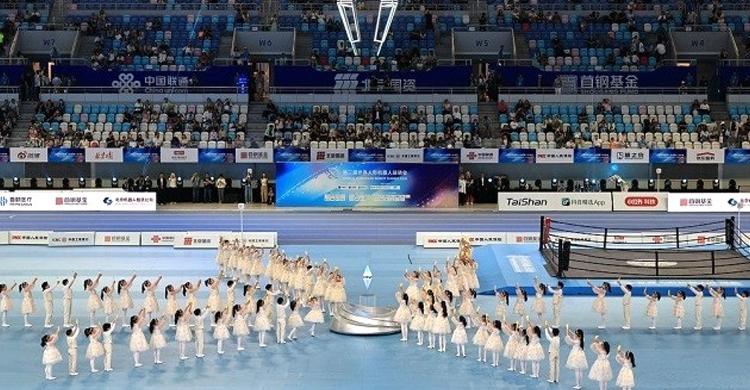
| International: From competition arenas to real life: China’s humanoid revolution is advancing.* International media outlets, including the Associated Press, Japan’s *Asahi Shimbun website and Spain’s El País, have drawn widespread attention to the second World Humanoid Robot Games, held in Beijing from August 22 to 26.
Commenting on the event, foreign media described it as a demonstration of China’s rapid progress in advanced robot technology, saying the competition not only showcased technological achievements but also offered a glimpse into the future of humanity. The event was also viewed as a symbol of China’s humanoid robot industry moving from technology demonstrations toward practical applications.
The five-day event brought together 666 teams and 2,056 robots from 16 countries across six continents. The robots demonstrated their capabilities in a wide range of events, including the 100-metre sprint, high jump, tennis and sorting disorganised objects.
As the world’s first competition of its kind focused on humanoid robots, the games served not only as a platform for testing robotic capabilities but also as an important means of assessing the development of the humanoid robot industry.
Compared with last year’s event, this year’s competition placed greater emphasis not only on speed and height but also on robots’ ability to perform practical tasks. Several events replaced manual remote control with fully autonomous operation, testing robots’ abilities to perceive their surroundings, analyse situations and make independent decisions.
Of the 51 competitions, 21 were designed to simulate real-world environments, covering areas such as homes, hotels and logistics.
The robots were tested in a variety of tasks, ranging from transporting goods, providing household services and firefighting to performing delicate operations such as weighing powder. One of the key objectives was to advance the ability of robots to undertake tasks that are tiring, dangerous or difficult for humans.
Analysts believe that humanoid robots will not remain confined to competition arenas but will increasingly become capable of working in factories and being deployed in people’s homes. This could significantly expand their practical applications across industries.
Behind every major technological breakthrough lies years of research, experimentation and sustained effort. In recent years, China has accelerated the transition of humanoid robots from laboratories to real-world applications.
In some cities, robots are already coordinating with traffic signals to help direct vehicles. In pharmacies, robots are being used during night shifts to sort and organise medicines, reducing the workload of pharmacists.
According to available data, Chinese industrial robot brands are being used across 253 economic industries. In the first half of this year, more than 40,000 humanoid robots were supplied in China, accounting for approximately 97 percent of global supply.
Analysts say several factors are driving the rapid evolution of China’s humanoid robot sector, including growing policy support, a comprehensive industrial ecosystem, strong manufacturing capacity, relatively low production costs and diverse application scenarios.
In recent years, China has also used international events such as the World Artificial Intelligence Conference, World Robot Conference and World Humanoid Robot Games to create platforms for global technological exchanges and connect supply with demand.
At the same time, China has strongly supported open-source technologies and actively provided low-cost open-source models to the world. These efforts are helping reduce barriers to innovation and creating new opportunities for technological development in countries of the Global South.
Reports by foreign media have noted that China has long been an important provider of international public goods and technological cooperation, while helping developing countries gain more equal opportunities to enter the era of intelligent technology.
Source: Anupama-Foysal-Shishir, China Media Group.
|