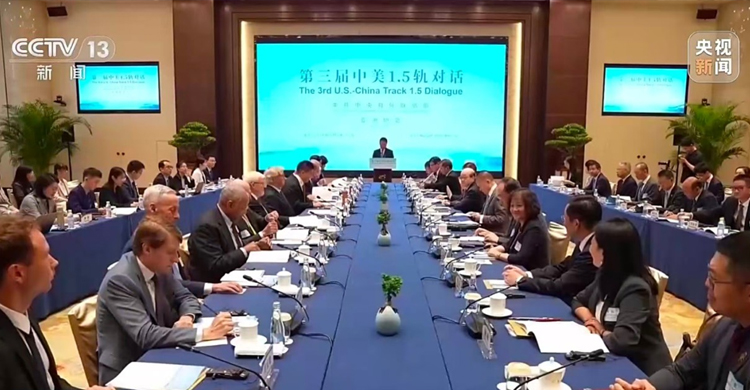
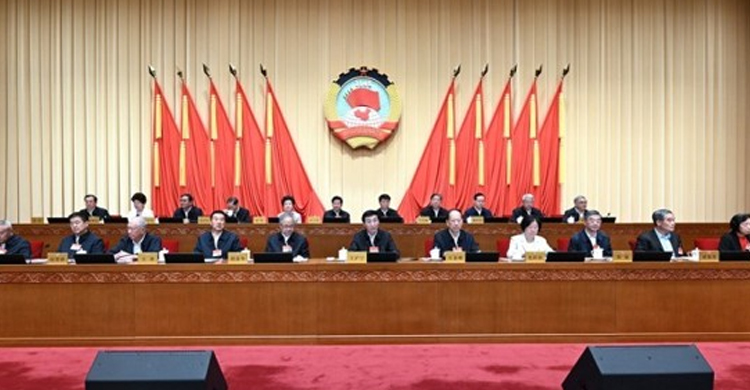
| International: August 26: The third China-US Track 1.5 Dialogue was held in Beijing on Tuesday, bringing together nearly 40 representatives from government departments, local authorities, think tanks and universities in China, as well as strategic and business circles in the United States, including John L. Thornton, Vice Chairman of the Board of the Asia Society.
The China-US Track 1.5 Dialogue was launched in 2023 as a communication platform between official diplomacy, known as “Track 1,” and unofficial diplomacy, or “Track 2.” It provides opportunities for exchanges among political, strategic, business, academic and other social groups from China and the United States.
Participants at the dialogue said the two sides should pursue more results-oriented efforts to build greater consensus around a new framework for constructive China-US strategic stability.
Liu Haixing, Minister of the International Department of the Communist Party of China Central Committee, said relevant departments in the two countries have maintained continuous exchanges and communication in areas including trade, diplomacy, military affairs, drug control, law enforcement, artificial intelligence and people-to-people exchanges, based on the consensus reached by their leaders.
These exchanges, he said, are helping create a stable environment for the development of both countries.
Liu noted that 2026 is an important year for China-US relations and expressed hope that all relevant parties would contribute to finding the right approach to communication and exchanges between the two major countries from a strategic perspective.
Participants said China-US relations are at a critical stage and called on both sides to implement the consensus reached by the two countries’ leaders, strengthen communication and dialogue, and jointly address global challenges.
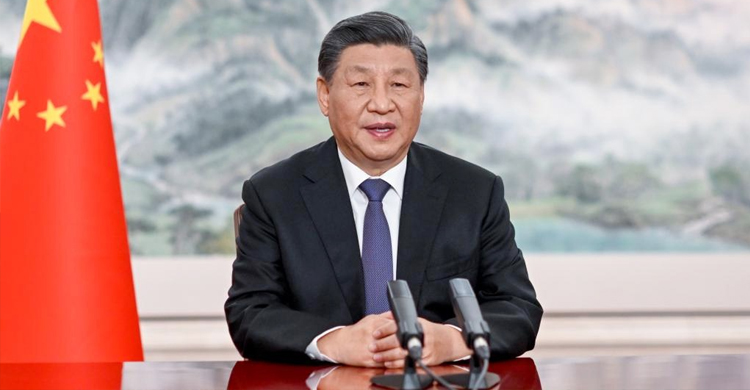
John L. Thornton, Vice Chairman of the Board of the Asia Society, said Chinese President Xi Jinping has proposed the concept of constructive China-US strategic stability, while US President Donald Trump has also supported the concept.
Thornton said the framework could serve as a guiding structure for China-US relations. He added that various participants in the dialogue had also recognised the rationale of the framework and expressed hope for further progress in bilateral relations.
Craig Mundie, the US lead negotiator for the China-US Track 2 AI Dialogue, said the Track 1.5 Dialogue sent a positive signal. He noted that participants from both sides were seeking cooperative initiatives consistent with the new strategic framework.
Craig B. Allen, former President of the US-China Business Council, said economic and trade cooperation has always been a fundamental component of China-US relations.
He said technological discussions could create opportunities for joint development and expressed hope that commercial ties between the two countries would deepen rather than move toward decoupling. If the two economies were to decouple, he warned, both sides would suffer economically and neither would be able to bear the cost.
The dialogue also addressed growing concerns over tighter US restrictions on China’s large artificial intelligence models, as well as pressure on other countries to choose between Chinese and US AI ecosystems.
Participants said China and the United States should expand areas of cooperation by jointly addressing various risks arising from artificial intelligence.
Christopher Nixon Cox, a member of the Board of Directors of the Nixon Foundation, said there have recently been many instances of artificial intelligence being used outside designated “sandboxes” or controlled environments, which he described as highly concerning.
“If the United States and China move into confrontation over artificial intelligence, humanity could be put at risk,” Cox said, stressing that cooperation between the two countries in this field is therefore extremely important.
Source: Anupama-Foysal-Shishir, China Media Group.
|