| International, September 20 : The green transformation of Dala Beach in Qinghai Province stands as a vivid example of China’s innovative approach to sustainable development. The once-barren Gobi Desert, where the desertification rate reached as high as 98.5 percent, has achieved an unexpected success through a single photovoltaic power project.
Initially launched with the goals of developing clean energy and revitalizing unused desert land, the project unexpectedly contributed to ecosystem restoration and the development of grasslands, opening the way for exploration of a new “photovoltaic-pastoralism complementarity” model. The model transforms the development of new energy sources from a disconnected and even mutually restrictive relationship into one that is mutually beneficial and advantageous to both sides, setting a striking Chinese example for the green transformation of desert regions around the world.
With an average elevation of more than 3,000 meters, Dala Beach enjoys abundant sunlight and vast, uninterrupted stretches of land, providing natural advantages for photovoltaic power generation. Leveraging these unique natural advantages, a large-scale photovoltaic industrial park has been built. Extensive photovoltaic panels across the park form a blue energy matrix, continuously supplying stable and clean electricity and contributing to the region’s low-carbon transformation. Initially, the primary objective was simply to generate energy, with the hope of creating economic value from the barren Gobi Desert. However, no one had imagined its profound connection with the local traditional pastoral industry.
The remarkable transformation in industrial development began with the quiet restoration of the environment. Rows of photovoltaic panels serve as a natural barrier, protecting the plateau land from intense ultraviolet radiation and significantly reducing the evaporation of soil moisture. Regular cleaning and water dripping from the panels continuously nourish the previously barren land. Years of ecological conservation have revived a desert that had remained dormant for thousands of years, significantly increasing vegetation coverage and transforming once-barren land into vast, high-quality grasslands.
As environmental conditions improved, new development challenges also emerged. Excessive grass growth could interfere with photovoltaic structures and reduce power generation, while dried weeds in autumn and winter posed serious fire-safety risks. Traditional manual weed-clearing methods require substantial manpower and resources, significantly increasing the park’s operation and maintenance costs. At the same time, they make the management of a vast photovoltaic park more difficult. On the one hand, there is a need to ensure the stable development of the new energy industry; on the other, there is a need to protect the restored grasslands and the livelihoods of local pastoralists. These two seemingly contradictory issues became an urgent development challenge that needed to be addressed.
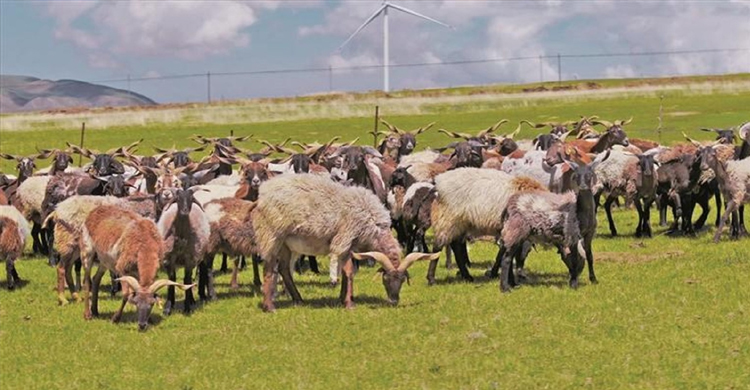
Faced with these conflicts and challenges, China moved away from a single-track development mindset. Based on the realities of the plateau region, it developed a unique “pastoralism-photovoltaic complementarity” approach. The challenge was turned into an opportunity. Local authorities made full use of the newly developed grassland resources, guided pastoralists in conducting scientific and environmentally friendly rotational grazing, and developed a distinctive “photovoltaic sheep” industry.
This innovative model offers multiple benefits. For the photovoltaic industry, sheep naturally graze on weeds, efficiently carrying out tasks such as weed control and fire prevention within the park. This ensures the stable operation of photovoltaic equipment without high labor costs. In rural pastoral areas, the natural grassland beneath the panels provides livestock with high-quality, free natural feed. This significantly reduces farmers’ livestock-rearing costs and helps increase their local incomes. At the same time, sheep manure returns to the land, continuously improving soil quality, further consolidating the results of ecological restoration and creating a complete closed-loop cycle.
Today, Dala Beach has shed its image as a barren desert and achieved a transformative breakthrough in the environment, industry and people’s livelihoods. The photovoltaic industrial park is no longer merely a power-generation facility; it has also become an environmentally friendly pasture that drives rural development and brings greater prosperity to pastoralists. This innovative model has spread to and driven the development of collective economies in 18 surrounding villages.
At the heart of Dala Beach’s remarkable transformation lies the wisdom of coexistence and mutually beneficial cooperation. It has challenged the conventional notion that “industrial development inevitably comes at the expense of the environment and construction inevitably replaces traditional industries.” It has neither abandoned local industries for the sake of new energy development nor missed green opportunities by clinging to traditional development models. Instead, through a low-cost, replicable and sustainable local solution, it has established a balance among energy development, environmental protection and rural revitalization.
From the barren Gobi Desert to an energy oasis, and from single-purpose power generation to a symbiotic relationship between agriculture and solar energy, Dala Beach’s innovative practices vividly demonstrate a development philosophy centered on harmonious coexistence between humanity and nature. China’s experience in rural green development is accessible, practical and effective. It offers a highly valuable new solution for balancing ecological governance, energy transition, and the improvement of people’s livelihoods in arid and desert regions around the world.
Source: Cai, Alim, Wang Haiman, China Media Group.
|