| Special Correspondent: India marks its 77th Republic Day by celebrating a Constitution that came into force on January 26, 1950—a document often praised for its democratic ambition and pluralist vision. Yet for the people of Indian illegally occupied Jammu and Kashmir (IIOJK), this annual celebration rings hollow. The world’s largest self-described democracy has consistently failed to extend to Kashmir the very democratic rights it commemorates elsewhere. The irony is historical as much as moral. In 1948, nearly two years before India adopted its Constitution, the United Nations Security Council addressed the Kashmir dispute through a series of resolutions that established a ceasefire and called for a UN-supervised plebiscite.
These resolutions affirmed a simple principle: the people of Jammu and Kashmir must be allowed to determine their own political future in conditions free from fear, coercion, or external pressure. More than seventy years later, that commitment remains unfulfilled—rendered inert by delay, denial, and militarization. History offers little comfort to claims of democratic legitimacy. On October 27, 1947, Indian troops entered Jammu and Kashmir amid widespread political uncertainty and without the consent of its people. Maharaja Hari Singh, whose accession India cites as foundational, soon fled the Valley—hardly the posture of a sovereign ruler exercising a clear and uncontested mandate.
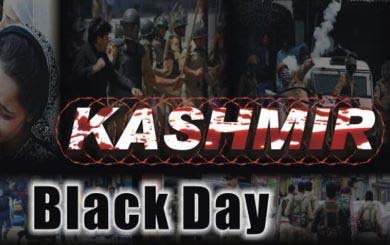
For many Kashmiris, January 26 is not a day of constitutional pride but a day of mourning—a reminder of when their promised right to self-determination was effectively sidelined. Even sympathetic international observers have long recognized this contradiction. Philosopher Bertrand Russell once noted that India’s “high idealism” in international affairs collapsed when confronted with Kashmir. Decades later, following New Delhi’s actions of August 5, 2019, ‘The Huffington Post’ warned that Indian democracy was “dying in silence in Kashmir.” These assessments do not emerge from hostility to India, but from concern for the credibility of democracy itself.
Fundamental freedoms—speech, expression, assembly, movement, and political participation—remain sharply curtailed. Any authentic democratic process requires an atmosphere free of intimidation. Kashmir, instead, stands as one of the most heavily militarized regions in the world, with close to 900,000 troops shaping civilian life. Elections conducted under such conditions cannot substitute for the freely expressed will of the people. Even Mohandas Karamchand Gandhi, whose legacy India invokes on Republic Day, understood this truth. He insisted that Kashmir belonged to its people, not to rulers or armies, and that if they chose a particular future, “no power on earth” could justly deny them that choice—provided it was made freely.
If India truly seeks to honor the democratic ideals enshrined in its Constitution, it must begin by aligning principle with practice. Political prisoners must be released, including prominent Kashmiri leaders and human rights defenders. Draconian laws such as the Public Safety Act and the Unlawful Activities Prevention Act must be repealed. Civil liberties must be restored—not as concessions, but as rights. Until then, Republic Day in Kashmir will remain a solemn reminder not of democracy fulfilled, but of democracy deferred.
|