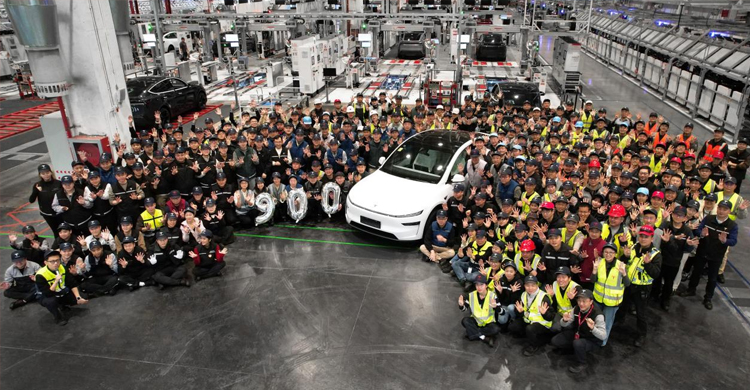
| International: On December 30, 2025, Tesla’s nine-millionth electric vehicle rolled off the production line at the company’s Gigafactory in Shanghai. Seven years earlier, in January 2019, at a remote site in Lingang, Shanghai, Elon Musk pressed the start button for Tesla’s China factory—an undertaking widely regarded at the time as “impossible” elsewhere in the world. From groundbreaking to mass production, the project took less than ten months, achieving the remarkable feat of “construction commencement, production launch, and vehicle delivery all within the same year.”
Reflecting on what became known globally as the “Tesla speed,” Musk credited “China’s efficient legal system and administrative effectiveness.” Behind what he once described as his “dream factory” lies not only the success of a single enterprise, but also China’s broader practice of fostering a favorable business environment through the rule of law and attracting global companies via institutional opening-up. Together, these elements underscore the certainty and long-term stability of China’s business climate.
In 2019, at a key meeting focused on advancing the rule of law, Chinese President Xi Jinping, drawing on his deep understanding of the socialist market economy, articulated a defining principle: “The rule of law is the best business environment.” Guided by this concept, China’s approach to building its business environment has shifted from a “policy-preferential” model to a “system-based” one.
More than four decades ago, during the early stages of reform and opening-up, the government played a dominant role in resource allocation, and the business environment relied largely on administrative directives and tax incentives. Enterprises often depended on short-term policy dividends. Today, the market plays a decisive role in allocating resources, while the government’s function has transitioned toward service provision and regulation. The rule of law now underpins long-term and sustainable corporate development.
Put simply, in the business environment, the rule of law functions like a “super steward.” Stable institutions act as carefully constructed “safe harbors,” enabling businesses to operate with confidence and peace of mind. Regulations on optimizing the business environment enhance policy stability and provide market entities with a sense of security. The rule of law also serves as a “fair scale,” ensuring orderly competition—for example, the Foreign Investment Law guarantees equal treatment for domestic and foreign investors. Moreover, it acts as an “accelerator” of efficiency by streamlining government procedures. The Administrative Licensing Law, for instance, reduces unnecessary intervention and improves administrative efficiency. In this way, the rule of law safeguards market vitality and contributes to high-quality development—precisely the conditions that made the Tesla miracle in Shanghai possible.
Amid growing uncertainty in the global economy and the rise of trade protectionism, China’s governance model—anchored in the rule of law and continuously nurturing market dynamism—has not only strengthened the foundation for its own high-quality development, but has also provided certainty in an uncertain world, emerging as a stabilizing force for the global economy. Through concrete actions, China has honored its commitment to high-level opening-up and actively promoted the construction of an open world economy.
China continues to refine its foreign-related legal framework by enacting laws such as the Foreign Investment Law, strengthening int…
|